I was blessed with an amazing public defender. Facing thirty years, I was sentenced to six. Once I was placed in the federal system, I threw myself into growth. I took a job teaching other incarcerated men who hadn’t finished school. I helped them work toward their GEDs. Helping them opened my eyes and gave me a deeper sense of purpose. Around that time, I met someone in my prison church group who became my spiritual mentor and closest confidant. We talked often about what we would do when we got out — about buying derelict houses, fixing them up, and turning them into affordable housing for people who needed a second chance.
I also enrolled in a nine-month drug rehabilitation program — an intense course focused on cognitive therapy and personal accountability. It challenged me deeply, but it changed me for the better. Then in February 2023, while I was still inside, my father passed away. We hadn’t spoken in years. He was angry with me, and I never got to explain, never got to say I was sorry, never got to make things right. That pain still echoes. But it also became a turning point. I refused to let the same thing happen with my mom.
From that day forward, I called my mom every single day. Every day. Her voice became my anchor, and I made sure she knew just how much she meant to me. All the effort I was putting in — the programs, the hard work, the change — it paid off. I was released after three and a half years, in August 2023, and sent to a halfway house.
I spent 10 months at the halfway house. Because of their rules, I wasn’t allowed to travel out of state to visit my mother. I reached out to my public defender again, and she filed a motion with the court. Meanwhile, I joined a Workforce Development program led by an international energy company. It didn’t promise a job, but it got me on their radar and put me on a list to receive emails about openings.
In January 2024, my motion was granted. I was finally able to visit my mom. I visited her every other weekend. We reconnected. We laughed. We cried. And we healed. Then, in February, that same energy company took a chance on me and offered me a temporary position as a customer service representative. I didn’t hesitate. I grabbed it — even though the commute was more than two hours each way.
I worked hard and stayed focused. Thirteen weeks into the fifteen-week training program, they offered me a permanent job. I’ll never forget the call I made to my mom that day. I could hear the pride in her voice. That moment — hearing her joy — filled my heart like nothing else. I had made it back, even better than ever before.
In May 2024, I transitioned from the halfway house to a sober house, sharing a two-man room. That same month, the probation department moved me to the lowest level of supervision. It was more proof that my hard work wasn’t going unnoticed. I was rebuilding a life — solid, honest, meaningful. Then, heartbreak struck again. On September 24, 2024, my mom passed away suddenly. I was devastated. But I was also at peace knowing that she died seeing her son become the man she always believed he could be. She saw me hold down a stable job. She saw me free from addiction. She saw me whole again. That knowledge gives me strength to this day.
In November, 2024, I reconnected with the friend I had met in prison — the one I dreamed with. We started laying the foundation for our business: buying and fixing up homes, turning them into safe, affordable housing. I still loved my job and helping people — especially struggling customers trying to keep their lights on. I knew where they were coming from. I saw them. I helped them. It felt like that’s where I was meant to be.
But as much as I loved the mission, the company’s performance metrics were difficult. They made it hard to focus on people instead of numbers. Still, I pushed through. Then in May of 2025, the company rolled out a major system upgrade and started offering overtime. I took it. I kept showing up.
By June 2025, I was still working a bit of overtime. The inheritance from my mother’s estate was due in a couple of months. Around that time, my roommate from the sober house — someone I’d lived with for over a year — was moved into a single room across the hall. I was facing a new transition, another change.
That same month, a motion my public defender had filed earlier — asking for early termination of my probation — was granted and I was no longer restricted to my state. And in the same stretch of days, my friend and future business partner offered me a place to stay in Baltimore if I ever wanted to join him there.
It felt like everything was aligning. God was making a way. So, I made a decision. I left the job, took the plunge, and headed to Baltimore to pursue the dream — the business, the calling, the next chapter. My friend came and got me. We didn’t look back.
This is not the end of the story. It’s the beginning of a new one. A story about redemption, purpose, and rebuilding from the ruins. A story about walking by faith, not by sight. I’ve seen what hopelessness looks like — and I’ve seen what happens when hope enters the room. And now, all I want to do is be a vessel for that same hope, to help others rise like I did. Because if I can come back from where I was, anyone can.
The Birth of an Idea:
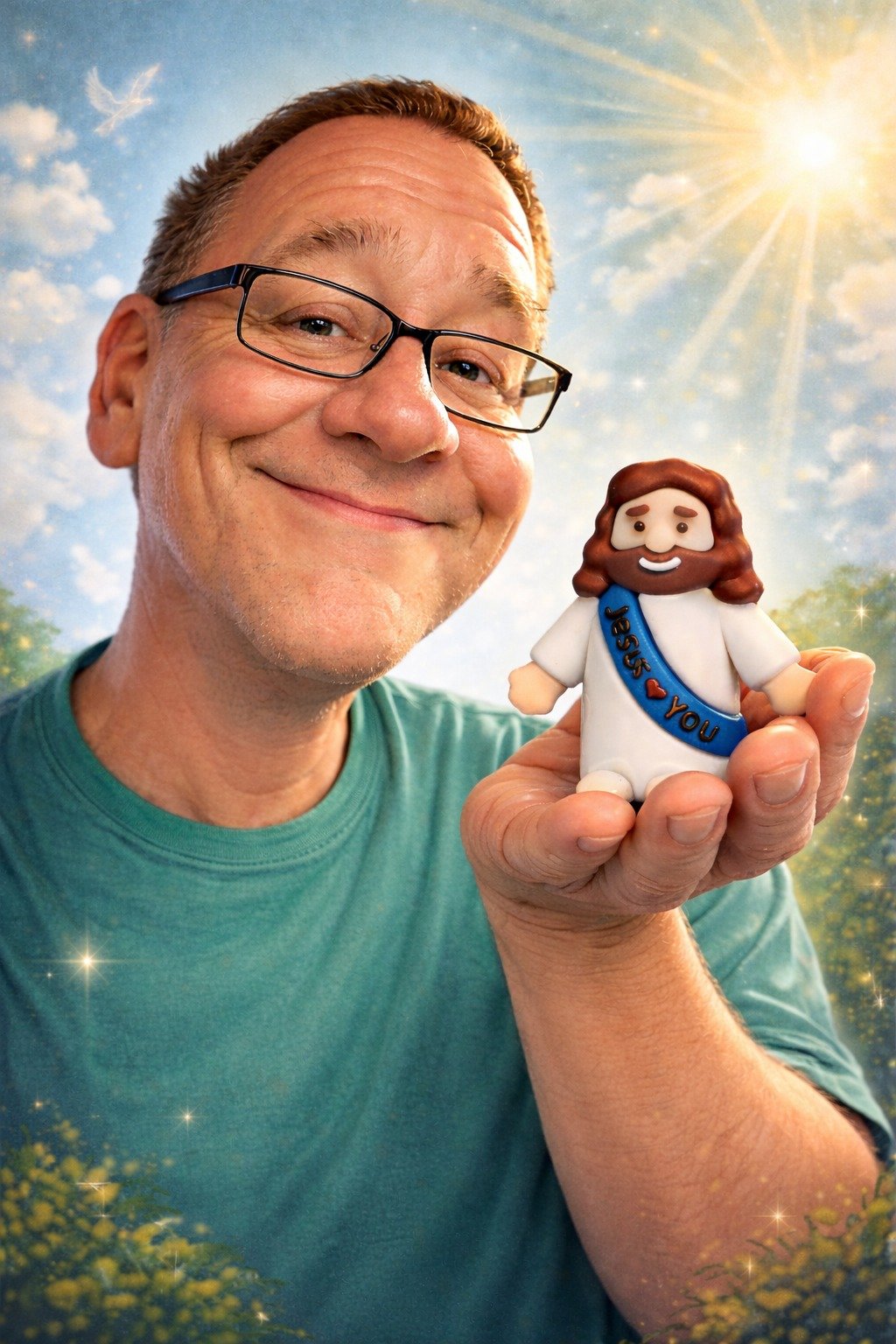
While I was in Baltimore, life had slowed to a strange stillness. I found myself with more free time than I knew what to do with, suspended in a kind of quiet limbo, waiting for my inheritance to come through. With no real obligations pressing in on me, I spent a lot of time scrolling on social media—sometimes just to pass the time, but often searching for something I couldn’t quite name. That’s when I started to notice a trend that stopped me in my tracks. People all over were leaving tiny Jesus figurines in public places—on sidewalks, benches, shop windows—as simple, silent gestures meant to inspire hope.
I’ve always been deeply moved by videos of people spreading kindness in unexpected ways, especially those influencers who ask strangers if they can spare a dollar or two. And when someone, out of the goodness of their heart, offers what little they have, they’re surprised with hundreds—sometimes thousands—of dollars in return. They’re asked to share their story, and if it’s especially touching, a GoFundMe campaign is started. And just like that, their entire life can shift. I used to watch those moments unfold and feel something stir inside me—this yearning not just to witness change, but to be the change.
Then, it hit me. Like a bolt of lightning straight to the soul. What if I could do something like that? What if I could take those tiny Jesus figurines and pair them with something more—something interactive and alive? What if I created a QR code that led to a website, where anyone who found one of these little figures could scan it and share their story? A place where others could read those stories, be encouraged by them, and maybe even have their own hearts changed in the process? What if the especially heartwarming ones could be featured on social media—shared widely, uplifted, celebrated? And maybe, just maybe, I could launch GoFundMe campaigns for people whose stories touched the world. Maybe I could help change lives, too.
I immediately started putting the plan into motion, I used some of what little money I had to purchase the appropriate web domains for my vision. I started social media accounts on all the platforms with the same names. Then I sat down to scroll before bed, and something unexpected happened. After all the time I’d spent on social media since getting out — hours and hours of mindless scrolling — I had never once seen an ad for Our Daily Bread. Not a single one. But that night, there it was. An ad for Our Daily Bread appeared on my feed, and the cover of the issue in the image stopped me cold. It was one I had received while I was still locked up — the very same issue. And on the cover were lupins. Lupins were my mother’s favorite flower. I’d kept that issue, tucked away in a box with other things I couldn’t let go of. But in that moment, it hit me: I had accidentally left that box behind in Boston when I moved. I’d never see it again. My heart sank. Before the feeling could fully settle, I took a screenshot. I just knew I had to. That image, that issue, that flower — it was a sign. A reminder. A whisper from above.
In that instant, it all came together. The tiny figurines. The idea. The movement. The moment. It wasn’t just a project. It wasn’t random. It wasn’t coincidence. It was something bigger. Whether it was my mom, or God, or both — something, was nudging me forward. This was more than just a calling. It was confirmation.
And that’s where it all began. The idea wasn’t just mine—it felt planted, intentional. Like something divine. Some sort of guidance from above saying, THIS is the path.
From Idea to Movement
What followed was not days or weeks, but an entire year of building
The idea had come in a moment, but bringing it to life would require thousands of decisions, countless revisions, and more persistence than I ever imagined. What began as a simple thought—a tiny figurine paired with a QR code—slowly evolved into something much larger. I wasn’t just building a website. I was trying to build an experience. A place where strangers could connect through shared stories, hope, and human connection.
Over the following year, I mapped out every detail of the movement. I developed the story-sharing process, the interactive map, the galleries, the community spaces, the outreach plans, and the systems that would allow people from different backgrounds and different parts of the world to participate in the same experience. Every page, every feature, every piece of content was built with the same question in mind: How can a small moment of discovery become something meaningful?
At the same time, I worked to establish the organizational foundation needed to support the vision. I secured fiscal sponsorship, developed long-term plans for growth, explored partnerships, built outreach strategies, created social media channels, assembled creative assets, and laid the groundwork for what I hope will one day become a lasting movement. I carefully mapped out every part of the experience—from the moment someone discovers a Tiny Jesus, to sharing their story, finding encouragement in the stories of others, and ultimately becoming part of the community themselves.
Every detail was considered. The platform was designed to allow participation without requiring accounts or signups because I wanted the experience to remain as simple and accessible as possible. Story galleries, photo galleries, interactive maps, community spaces, outreach tools, and anonymous participation features were developed with the goal of making the movement welcoming to everyone. Because my own journey included struggles with depression, anxiety, and suicidal thoughts, I also made sure that the Suicide & Crisis Lifeline would always be visible and accessible throughout the site for anyone who might need it. Even the music, visual identity, colors, messaging, page layouts, and overall atmosphere were intentionally selected and refined to create an experience centered around hope, reflection, and human connection.
What had started as an idea was gradually becoming something real.
The road was not always smooth. There were delays, setbacks, redesigns, financial challenges, and moments when the finish line seemed to move farther away instead of closer. More than once, I questioned whether the path would ever become clear. But over time, I began to see those obstacles differently. What once felt like roadblocks started to feel like preparation. Each challenge forced me to slow down, think more carefully, strengthen the vision, and address details that might otherwise have been overlooked. Looking back now, I believe many of those struggles helped shape not only me, but the movement itself. They helped ensure that when launch day finally arrives, the foundation beneath it will be stronger, more thoughtful, and better prepared for whatever comes next.
Today, what you see here is the result of that year-long journey. Not just a website, but the beginning of a community. A place built on the belief that hope can appear in unexpected places, that stories matter, and that even the smallest gesture can create a ripple effect far beyond what we can see.
The idea may have arrived in a single moment, but the movement was built one step at a time.
Today, what you see here is the result of that year-long journey. Not just a website, but the beginning of a community. A place built on the belief that hope can appear in unexpected places, that stories matter, and that even the smallest gesture can create a ripple effect far beyond what we can see.
What started as a simple idea has grown into something far greater than I ever imagined during those first moments of inspiration. Looking back now, I find it even harder to believe that the idea was merely a coincidence. The same feeling that was present in the beginning—that this idea was planted, intentional, and somehow guided from above—has only grown stronger throughout the journey. While the work is far from finished, the foundation has now been laid.
The vision is clear, the community is waiting, and the next chapter belongs to everyone who becomes part of the story.